



🐐 Membership | 🔍 Find Answers | 🛒 Shop | 📢 Partner With Us
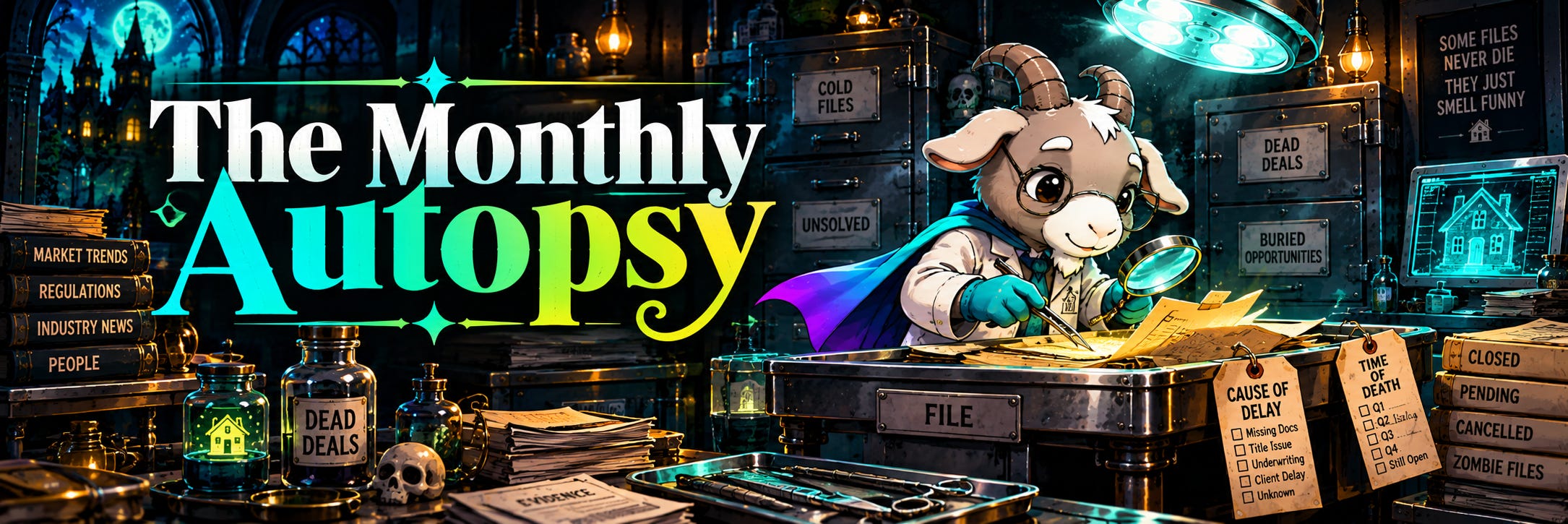
🩻 The Monthly Autopsy
Apparently Everything in the File Needs a Second Look
Deepfakes, fake surveys, bad source data, unrecorded mortgages, thinner deals—and a housing market that keeps creating new kinds of work instead of simply “recovering.”
September kept circling the same uncomfortable idea from completely different directions: a file can look internally consistent and still be wrong.
Three vendors can repeat the same bad upstream data. A Closing Disclosure can say a lien was paid while the land records disagree. A survey can look legitimate and still be fake. A mortgage can supposedly be handled at closing and never make it into the public record. A seller can appear on camera and still not be the seller.
The old version of verification was largely transactional: check the identity, check the record, check the document, clear the condition, move on.
September looked more like a verification stack. Where did the information come from? Is the second source actually independent? Does the document agree with the public record? Does the person match more than an ID? If software flags something, who decides what happens next? And when AI or a vendor gets it wrong, who owns the mistake?
That theme ran straight through fraud, title search, AI, surveys, liens, post-closing, vendor oversight and even the housing market itself. The recurring risk was not simply bad information. It was confidence in information that had not earned it.
Brought to you by our friends, contributors & sponsors:🔒 Closinglock, 🌍 Foreign Tax CPA, 🪄Business Witch Academy, 🧱 Brickhouse Consulting, 🖊️Dotted Line Signings & Our Paying Readers
📢 Be a Sponsor
1. Verification Is Becoming Its Own Workflow
We opened the month asking whether three matching vendor answers really count as independent verification when they may all trace back to the same bad source. Then the examples got less theoretical.
We saw AI-assisted title work miss property-history context, seller-impersonation fraud move into deepfakes, a supposedly paid lien remain alive in land records, mortgages that were never recorded, a survey that may have been fabricated and a deed allegedly signed by someone who was already dead.
Different problem. Same operational question: what is your actual source of truth, and what happens when two “truths” disagree?
The useful shift is not adding one more checkbox to the file. It is designing the escalation path for the moment the evidence stops lining up.
2. AI Is Past the Demo Stage. Now Somebody Has to Own the Mistake.
September’s AI stories were not really about whether the technology can save keystrokes. We are already past that conversation.
AI is being pushed into search, examination support, fraud detection, customer communication, workflow routing and CRM decision-making. At the same time, regulators, underwriters, agents, vendors and E&O carriers are still sorting out where responsibility sits when automated work is wrong, incomplete or built on bad data.
That tension is going to matter more than the novelty of the tool. Automation can remove duplicate entry and handoffs. It can also move a bad assumption through the workflow much faster.
The competitive advantage is not “we use AI.” It is knowing which work can be accelerated, which decisions still require judgment, and who is accountable when the machine hands you a very confident answer that should not survive the file.

3. The Transaction Mix Is Changing Faster Than the Transaction Count
The housing market still refuses to deliver the clean recovery story everyone keeps waiting for.
Renters are staying put. Recent buyers are showing more financial strain. Sellers have less room to absorb surprises. Second liens are gaining ground. The lock-in effect is creating its own lien and equity problems. Mortgage-rate relief keeps colliding with inflation, Treasury yields and forces well upstream from housing.
Meanwhile, work is appearing in places that do not look like a return to the old market: C-PACE, data-center development, foreign-buyer restrictions, manufactured-housing changes, first-time-buyer programs, curative work and increasingly complicated financing structures.
That is why “wait for volume to come back” keeps looking less like a forecast and more like a refusal to choose a growth strategy.
This month we followed that idea from the weekly market signals into The Housing Recovery Is Not Your Growth Plan and then much farther upstream in the 2027 Wicked Title Volume Trends Report. The point is not that housing never recovers. It is that the agencies building revenue now are not waiting for one national number to rescue them.
🚨 Customize your Wicked Title Email Delivery
Did you know that you can customize your Wicked Title Email Delivery?
Perfer to read in the Substack app instead of your inbox? Change your Substack settings here →
Want the Sunday Title Underground and the Monthly Digest only? Select “🐐WTF is Happening?📰” and unselect the other options here →
😈 Wicked Sense of Humor

👀 Worth Reopening

The Dirt Is Only Half the Deal: Data Centers Are Becoming Infrastructure Title Work
We flagged data centers in August because the title work follows more than the land. September added another layer: zoning fights, permitting disputes and local moratoriums are showing how quickly the infrastructure boom can turn into a land-use problem before the next transaction ever reaches the closing table.
If data centers looked like a niche commercial story a month ago, they are starting to look more like a recurring example of how upstream infrastructure policy becomes downstream title complexity.
🐐 Everything Wicked This Month

If you missed a week—or wisely refused to let your inbox become your full-time job—here is the coverage since the last Monthly Digest in one place.
Sunday Title Underground
Florida’s LLC Has Babies, Utah Makes Buyers Pick Their Poison, & Romania Loses the Whole Damn Registry — Truist Park title work, a failed Philadelphia bank’s liens, Romania’s land-registry attack, earlier price cuts, second liens, FHA distress and an AI sales sidekick.
A Locked Gate, A Dead Woman’s Signature and A Buyer Who Forgot They Could Move — owner-versus-insured confusion, first-time-buyer friction, second liens, AI title search, CFPB reform, wire fraud, QR phishing, crypto mortgages and one deeply questionable signature.
Plywood at the Closing Table, 813,000 Underwater Borrowers & Buyers Who Keep Clicking “Save” — credit scoring, AI search misses, beach-boundary fights, tariff pressure, recent-buyer distress, vendor oversight, ROAD implementation, TOD deeds and two South Carolina land-use fights.
The Fed Hiked. Mortgage Rates Jumped. Seller Impersonation Fraud Doubled… — deepfakes, unrecorded mortgages, bad lien evidence, fake surveys, data-center moratoriums, lock-in liens, post-closing fraud tools, CFPB changes and title-agency continuity planning.
Your CRM Knows Who Ghosted You, FHA Wakes Up After 20 Years & Sellers Run Out of Cushion — fraud tools, appraisal bottlenecks, thinner deals, CRM data, first-time-buyer savings proposals, FHA property standards, foreign-buyer restrictions and a fresh batch of state closing changes.
Original Features, Analysis & Tools
AI, Aggregated Data, and the Next Fight Over Who Gets Left Holding the Bag — what happens when multiple vendors agree because they inherited the same bad source data, and where responsibility lands when AI-assisted title work fails.
Notarial Wording: The Small Detail That Can Sink a Closing — a short reminder that the stamp is not the whole notarization.
C-PACE: From Clean Energy Initiative To Liens That Survive Closing and Other CRE Developments — why a growing slice of commercial financing deserves more attention before someone calls it “just another lien.”
The Housing Recovery Is Not Your Growth Plan — where title companies are finding revenue anyway, and why waiting for mortgage rates to solve your business plan is getting increasingly expensive.
Is 2027 Finally the Year Title Volume Comes Back? — the 2027 Wicked Title Volume Trends Report follows housing backward into the forces that move it, then forward into the signals worth watching next.
🐐 Wicked Title Folks🧠

September also brought contributor pieces worth keeping in the file drawer for the day a “simple” issue stops being simple.
🌍 Foreign Tax CPA: FIRPTA: Why Hiring a CPA Is Crucial — why FIRPTA withholding, ITINs, refunds and IRS compliance are not a great place to improvise.
🌍 Foreign Tax CPA: When the IRS Gets It Wrong — a real FIRPTA example where correct filing did not prevent an IRS error from creating serious downstream consequences for the buyer.
☕Ramblings of a Title Man: The Incorrect Correction that Accidentally Started a Lawsuit — one scrivener’s-error fix, two lots and a very good reason not to assume every apparent typo is actually a typo.
🖊️ Want to be a content contributor? Contact us
🧪 Wickedly Useful

You read the news. Now go learn the thing behind the news. A handful of deeper resources from this month’s research pile that are worth keeping for the next weird file:
Types of Liens: Recorded vs. Unrecorded, for Title & Escrow — useful background for a month full of payoff assumptions, lingering liens and financing structures that refuse to behave like ordinary mortgages.
Practical Details Title Professionals Should Examine When Reviewing a Survey — a timely refresher after a month in which even the survey itself made the fraud list.
🔒 The rest of this month’s Wickedly Useful pile gives paid members 4 more educational resources you can use to train your staff, level up your skills, and be glad that you bookmarked before the weird file shows up. Want instant access? Grab it here!
📌 If this helps you do your job better, faster, or safer—support it.
Upgrade your membership and keep this kind of work independent, honest, and actually useful.
Stay Wicked,
Cheryl
Contact Me (or hit reply)

The Wicked Title Forum is a collaborative resource. If you spot something outdated or inaccurate, leave a comment—we’ll get it fixed.
**DISCLAIMER**
Content is for informational purposes, operational awareness and workflow strategy. While every effort is made to ensure accuracy, it is not meant to be a compliance directive or replace the specific legal/financial advice of your retained experts. As always evaluate new information & tools with your underwriter/attorney, accountant/financial advisor, IT/security team, and internal policies, as needed, before implementation.
This site is partially supported by sponsor ads and sponsored content.