


🐐 Membership | 🔍 Find Answers | 🛒 Shop | 📢 Partner With Us
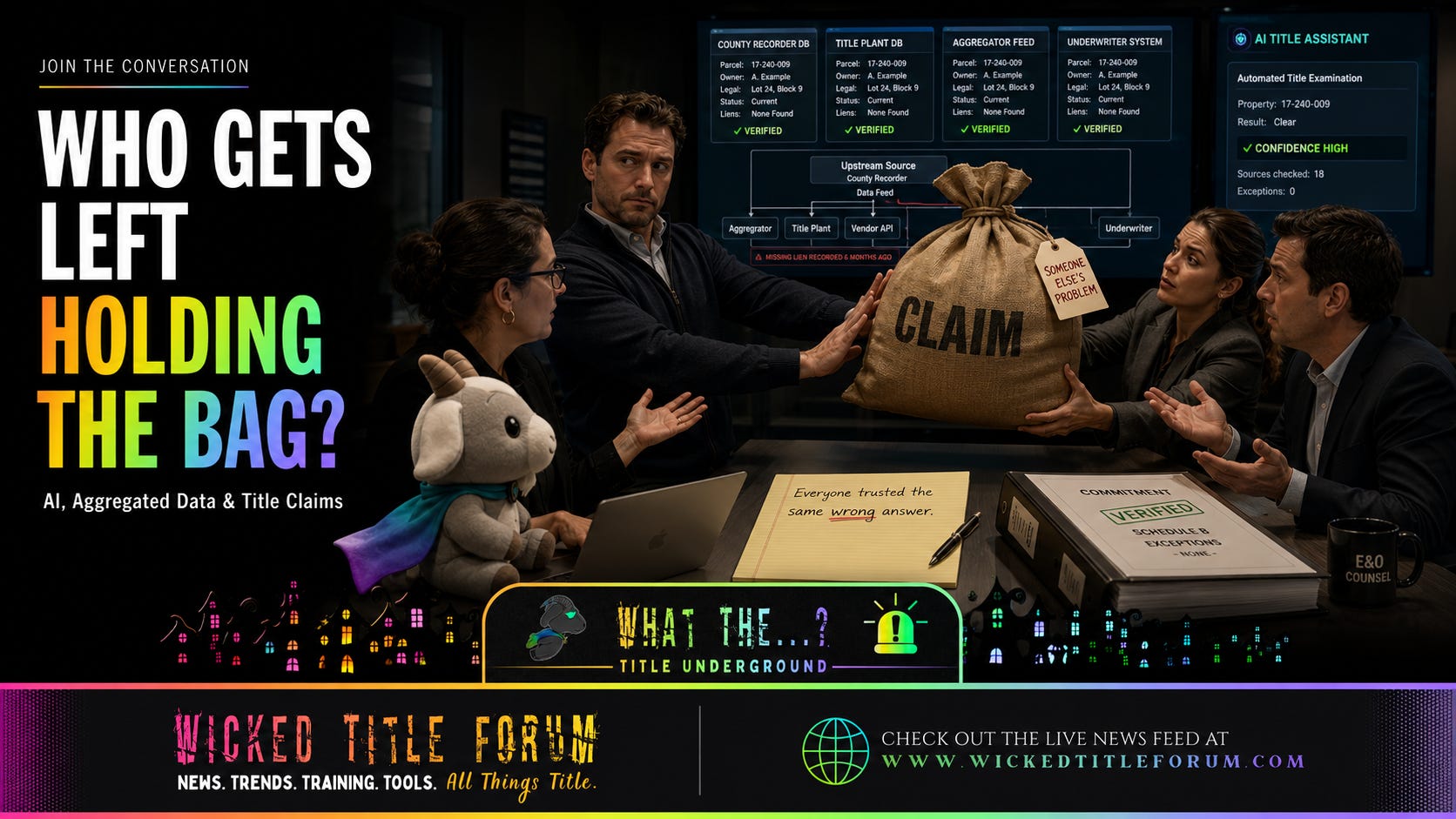
A reader raised a deceptively simple question under our recent story about property-data brokers producing the same errors from the same underlying records: if three vendors all repeat the same bad source data, have you independently verified anything—or just confirmed the same mistake three times?
Zuriel Galvez of DeedFlex put it plainly in the comments: the bigger problem may not be the error rate itself, but the illusion of verification. If three vendors all inherited the same bad upstream record, three matching answers can look like confirmation when they are really one mistake wearing three different logos. He asked whether title has any real convention for tracking provenance—or whether that is still largely left to individual vendors.
Then this follow-up landed: when data comes from a third party, who is responsible for its accuracy?
That question gets considerably more interesting when you add AI. Texas insurance regulators are already putting responsibility for AI governance back on regulated companies even when third-party systems are involved, and Fannie Mae has taken a similar position with lenders using AI vendors: outsourcing the technology does not outsource oversight.
But title has another layer nobody seems to have answered yet: what happens when the bad data actually becomes a claim?
Suppose an aggregated title-data source misses a lien. Or several “independent” databases repeat the same corrupted record. Or an AI examination tool reaches the wrong conclusion because its upstream data was incomplete. A policy gets issued. The defect surfaces later.
Who ultimately eats the loss?
The insured may still have a covered title claim; title insurance exists to respond to covered defects according to the policy, and the issuing agent is not ordinarily the party contractually responsible for paying the policyholder’s covered loss. But that does not necessarily end the story between the underwriter and the agent. Courts have enforced agency agreements requiring agents to reimburse underwriters for losses caused by negligent search or examination errors, and some agency agreements expressly place those losses back on the agent.
Then comes the E&O question. The broader professional-liability market is still figuring AI out. Current commentary on AI exclusions and professional-liability coverage says ordinary negligent reliance on bad AI output may fit traditional E&O coverage, but policy definitions, third-party technology limitations and new AI exclusions can change that answer dramatically.
There does not appear to be a reported title-industry case yet telling us exactly how a title agent’s E&O policy would respond when the underlying mistake came from aggregated third-party data or an AI vendor.
Which leaves some questions I would genuinely like title people, underwriters, E&O brokers, vendors and claims people to argue about:
If the title agent reasonably relied on an approved vendor, is that negligence?
Does “verification” require going back to the original public record—or can validated vendor data ever be enough?
If five vendors use the same upstream source, should anyone be calling that five-sourced data verified?
If an underwriter approved or required the technology, should the agent still absorb the loss?
Does your current agency agreement say who owns a vendor-caused search error?
Has anyone actually asked their E&O carrier whether AI-assisted examination or third-party data errors are covered?
This may be one of those issues where the technology is moving faster than the contracts allocating the risk.
👉 Join the conversation on the original issue or start a new one below—
How do you think these claims will actually be handled?
Would a covered title claim still be paid first and fought over later between underwriter, agent, vendor and E&O carrier?
Have you seen any new language in your agency agreements or E&O policies that addresses who ultimately absorbs the loss or what steps you should be taking to ensure you’re in compliance?
And are carriers already changing exclusions, underwriting questions or risk controls because of AI-assisted title work and third-party data?
I want to know, what are you seeing and what do you think?
Stay Wicked,
Cheryl
Founder, Wicked Title Forum
Because knowing what’s happening isn’t the same as knowing what to do about it.
Contact Me (or hit reply)
🐐 Membership | 🔍 Find Answers | 🛒 Shop | 📢 Partner With Us

The Wicked Title Forum is a collaborative resource. If you spot something outdated or inaccurate, leave a comment—we’ll get it fixed.
**DISCLAIMER**
Content is for informational purposes, operational awareness and workflow strategy. While every effort is made to ensure accuracy, it is not meant to be a compliance directive or replace the specific legal/financial advice of your retained experts. As always evaluate new information & tools with your underwriter/attorney, accountant/financial advisor, IT/security team, and internal policies, as needed, before implementation.
This site is partially supported by sponsor ads and sponsored content.