



Your title production file has a beginning and an end.
The buyer’s money does not care.
The earnest money deadline may start running before your team receives the contract, opens the order or sends the welcome email. If the deal falls apart, the file may be cancelled long before the deposit is authorized, returned, delivered and reconciled.
Those are the two dead zones in many earnest money workflows:
Before the file exists
After the transaction ends
Everything between those points may be beautifully digital. The edges are often held together with email, check stock and whichever employee happens to notice the problem first.
Dead Zone One: The Contract Exists. Your Title File Does Not.
Real estate contracts have an irritating habit of being signed outside title company business hours.
The buyer signs Saturday afternoon. The earnest money deadline begins ticking. The real estate agent wants to provide immediate instructions. The title company has not received the order, created the file or invited the buyer into its secure portal.
This is how delays, frustrations, workarounds and security risks are born.
Maybe someone forwards instructions from an old email. An unidentified wire is sent. A title agent is now receiving suspicious notifications from their bank’s automated system at 9am on a Sunday while standing on the side of a soccer field handing out Gatorade to 8 year olds while trying not to panic.
Or a buyer is told they need to wait until business hours on Monday, when the title company is open. Only by then the buyer will be 10,000 feet in the air on their way to a business meeting in Shanghai. And the clock keeps ticking.
None of those options creates the high quality customer service, financial security or consistency title agencies want around buyer funds.
A better pre-file payment process should give the buyer one secure, consistent place to submit funds without requiring staff to create the transaction first. It should also collect enough information to identify the payment, notify the right people and match the funds to the file when it arrives.
Because letting buyers pay anytime is only helpful if “anytime” does not produce Monday morning’s mystery deposit.
🧠 Solve a Problem | 🔔 Upgrade Now | 🛒 Shop | 📢 Be a Sponsor
Dead Zone Two: The Deal Is Dead. The Work Is Not.
A cancelled transaction may disappear from the closing calendar, but it remains stubbornly alive in the operations queue.
The agency may still need to:
Obtain the required release authorization
Confirm who is entitled to the funds
Prepare and approve the refund
Update the escrow records
Communicate with the buyer and agents
Track delivery or check clearance
Preserve the supporting documentation
The closing revenue is gone. The workload apparently did not receive the memo.
And after collecting the earnest money electronically, many agencies still return it using a process involving a printer, an envelope and an optimistic faith in the postal system.
We verified your bank account well enough to take the money digitally. Now please allow seven to ten business days while we locate a stamp.
Perfectly modern. No notes.
Meanwhile, the buyer is anxiously awaiting their funds so they can make another offer.
What Those Dead Zones Are Actually Costing You
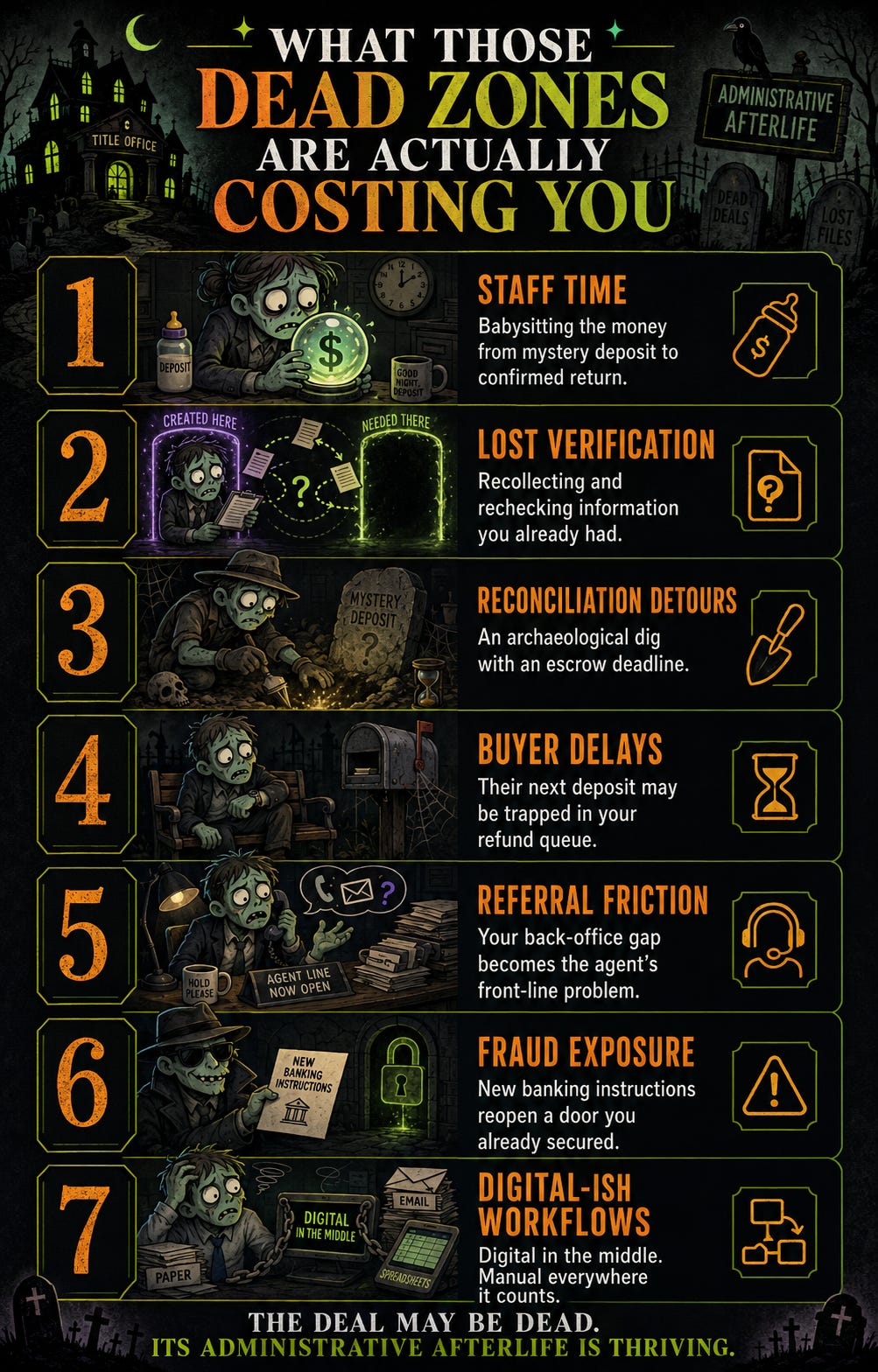
The problem is not limited to one late deposit or one refund check. Every time buyer funds fall outside the normal workflow, the agency pays for it—in labor, risk, buyer frustration and information it already collected but somehow forgot how to use.
1. Staff Time Spent Babysitting the Money
Someone has to identify the pre-file payment, match it to the order, answer the buyer, prepare the refund, update the escrow records and confirm delivery.
None of those tasks looks especially expensive on its own. Stack them across every exception, cancellation and status call, and suddenly a process nobody measures is eating hours of skilled staff time.
The deal may be dead. Its administrative afterlife is thriving.
2. Verified Information Thrown Away Between Steps
The buyer has already been identified. The bank account has already been verified. The money has already been connected to the transaction.
Then the payment changes direction and the workflow develops amnesia.
Every unnecessary handoff adds work. Every new request for banking instructions creates another opportunity for an email to be intercepted, information to be entered incorrectly or or a staff workaround to become the unofficial process.
Verified information should stay with the money—not disappear because the process crossed into another system.
3. Mystery Deposits and Reconciliation Detours
Accepting money before a file exists solves the buyer’s timing problem only if the agency can identify and match it later.
Otherwise, staff are left comparing bank activity, emails, buyer names, property addresses and payment amounts until somebody solves the puzzle.
That is not automation. That is an archaeological dig with an escrow deadline.
4. Buyers Stuck Waiting for Their Own Money
To the title company, an earnest money return may be one more cancellation task.
To the buyer, it may be the deposit needed to make the next offer.
A slow refund can keep the buyer from moving forward, generate repeated status calls and turn an already disappointing transaction into an ongoing financial problem. Collecting the money digitally and mailing it back by check does not make the delay easier to explain.
5. Referral Partners Managing Frustration They Did Not Create
When the buyer cannot get clear payment instructions—or cannot find out when a refund is coming—the real estate agent usually hears about it too.
Now the agent is chasing answers, calming the client and waiting for funds before helping the buyer pursue another property. The title company’s back-office gap has become the referral partner’s front-line service problem.
A smooth funds process helps agents keep their clients moving. A clumsy one gives them a reason to reconsider who handles the next deposit.
6. Fraud Exposure Reintroduced for No Good Reason
Every new request for banking information creates another opening for interception, impersonation, altered instructions or human error.
If the agency already verified the account used to submit the funds, starting over for the return may add risk without adding meaningful protection. The safer workflow preserves the original verification, requires proper release authority and controls the return from approval through confirmed delivery.
7. A Digital Process That Is Only Digital in the Middle
A payment button does not make the entire earnest money workflow digital.
If staff still rely on email to identify funds, spreadsheets to track exceptions, manual entry to connect systems and paper checks to return deposits, the agency has digitized a transaction—not the process surrounding it.
The real cost of the two dead zones is all the manual work required to bridge them. A complete workflow should remember who sent the money, where it came from, which file it belongs to, who authorized its return and whether it reached its destination.
Anything less leaves staff carrying the missing connections around in their heads.
Closinglock Reanimates the Dead Zones
🔒 Closinglock has introduced two capabilities designed to address these workflow gaps.
Its SecurePay open payment link gives title companies one standing link that buyers can use to submit earnest money, option fees, cash to close and other permitted payments—even outside business hours or before the file has been opened. Agencies can place the link on their website, in introductory emails, in email signatures or in materials provided to real estate agents.
Payments received before the order exists can be matched to the file after it is opened.
Melissa Neesen, vice president of operations at Reliable Title, said the company added the link to its introductory letters and began receiving secure earnest money payments immediately.
“No file needed, no data entry, and it’s working really well,” Neesen said.
That is the operational standard agencies should look for. The goal is not merely to accept money earlier. It is to accept it earlier without creating extra detective work later.
On the other end, Closinglock’s buyer EMD return workflow allows an authorized refund to be sent to the bank account verified when the buyer made the original payment. According to the company, buyer and bank information is prefilled, the process includes internal approvals, status tracking and an audit trail, and the money reaches the buyer the next business day.
The real improvement is not simply that money moves faster.
It is that the inbound payment and outbound return no longer behave like two unrelated events.

Audit the Entire Life of Buyer Funds
🔒 Closinglock describes its new payment link and buyer EMD returns as two parts of one secure money-movement platform. The company reports protecting more than $800 billion across two million real estate transactions, with no funds lost to fraud. Its existing SecurePay platform supports digital earnest money and cash-to-close payments, and ALTA has previously reported that SecurePay moved billions in good-funds-compliant payments. Closinglock’s platform overview and ALTA’s coverage of Closinglock’s payment operations provide additional background.
Whether an agency uses Closinglock or another payment process, it should evaluate the entire life of the money.
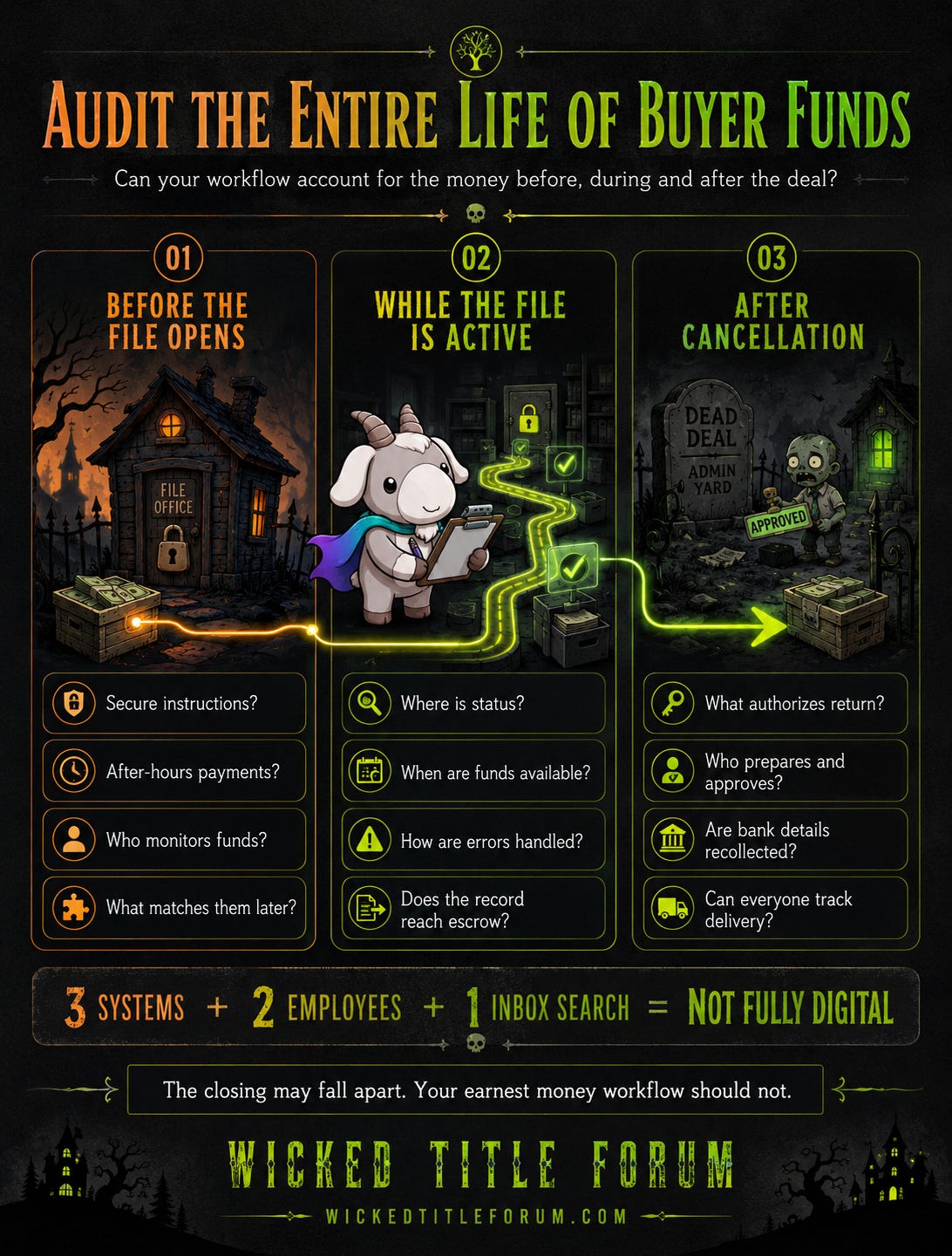
Before the file opens
Can the buyer obtain secure, consistent payment instructions?
Can funds be submitted outside office hours?
Who monitors payments that arrive before the order?
What information will be used to match the payment later?
While the file is active
Where can staff see the payment status?
When are the funds considered available?
How are exceptions, incorrect amounts and duplicates handled?
Does the payment record flow into the agency’s production and escrow records?
After the transaction is cancelled
What documentation authorizes the return?
Who prepares and approves it?
Is the agency unnecessarily collecting new banking information?
Can staff and the buyer track delivery?
What proof remains in the file when the process is complete?
If the agency cannot answer those questions without checking three systems, asking two employees and searching through email, the earnest money workflow is not fully digital and not adequately documented.
The file may open after the money arrives.
The closing may fall apart.
Your earnest money workflow should not.
Stay Wicked,
Cheryl
Contact Me (or hit reply)
🐐 About Wicked Title | 🔔 Subscribe | 🛒 Shop | 📢 Be a Sponsor

The Wicked Title Forum is a collaborative resource. If you spot something outdated or inaccurate, leave a comment—we’ll get it fixed.
**DISCLAIMER**
Content is for informational purposes, operational awareness and workflow strategy. While every effort is made to ensure accuracy, it is not meant to be a compliance directive or replace the specific legal/financial advice of your retained experts. As always evaluate new information & tools with your underwriter/attorney, accountant/financial advisor, IT/security team, and internal policies, as needed, before implementation.
This site is partially supported by sponsor ads and sponsored content.