



🐐 Membership | 🔍 Find Answers | 🛒 Shop | 📢 Partner With Us
CertifID’s acquisition of Closinglock brings together two major real estate fraud-prevention platforms to protect more of the title and escrow transaction from identity fraud, wire fraud, payoff fraud, seller proceeds fraud and Business Email Compromise. Combined with CertifID’s earlier acquisitions of Paymints.io and CloseSimple, the strategy connects identity verification, secure communications, digital payments, payoff verification, escrow workflows, insurance and fraud recovery across more of the closing process—reducing the gaps and handoffs fraudsters exploit.
Fraudsters Are Like Cockroaches
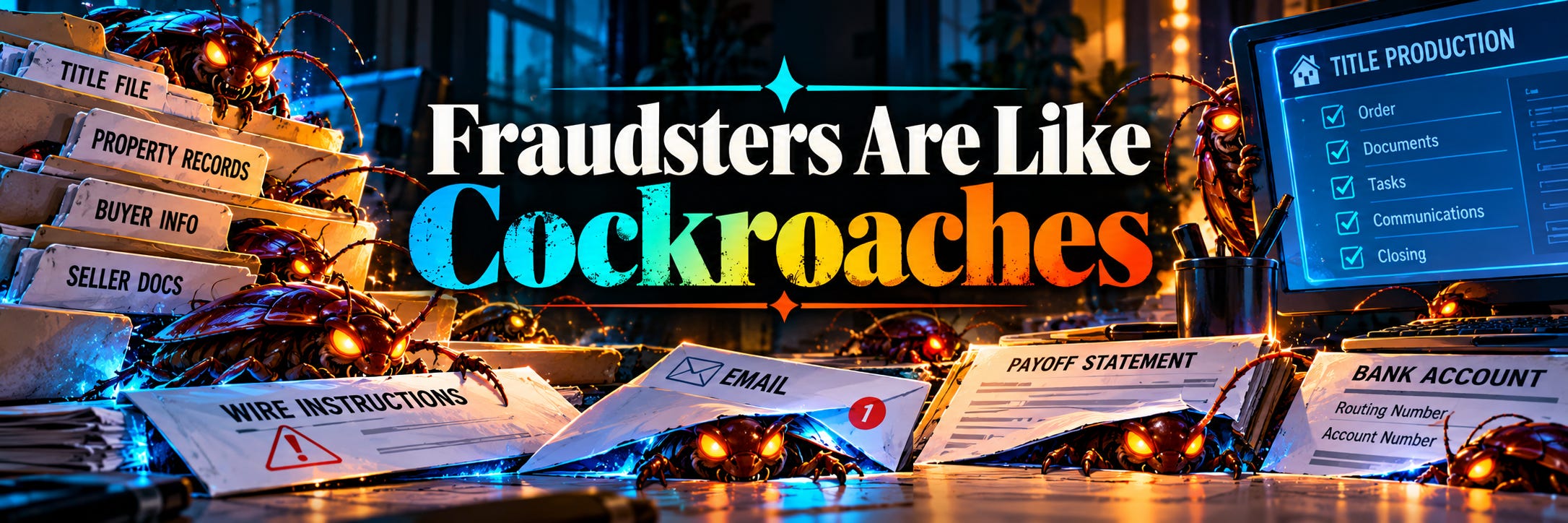
Fraudsters are like cockroaches: they don’t need to break through the front door if they can slip through a crack.
That is increasingly the problem with real estate fraud. Title companies may have strong controls around identity verification, wire instructions, payoffs, payments and client communication, but every handoff between those controls can create another opening. CertifID has just announced the acquisition of Closinglock. This brings two of the industry’s best-known fraud-prevention companies together at exactly those vulnerable seams, combining identity verification, secure money movement, escrow workflows and transaction protection with CertifID’s broader fraud intelligence, recovery and closing platform.
And when you add CertifID’s earlier acquisitions of Paymints.io and CloseSimple, the strategy becomes clearer: protect more of the transaction inside a connected, trusted workflow instead of forcing title companies to stitch together a collection of individually secure systems and hope the gaps between them hold.
You Can’t Build an Impenetrable Fortress with Duct-Tape

The FBI’s 2025 Internet Crime Report recorded 24,768 Business Email Compromise complaints and more than $3 billion in reported BEC losses.Real-estate-related complaints alone accounted for $275.1 million in reported losses, up from $173.6 million the year before. BEC is especially dangerous in real estate because the scam does not necessarily begin with an obviously fake message. Criminals can compromise a legitimate email account, watch the transaction develop and step in when money is expected to move. The FBI also warned that AI can make those attacks more convincing, using generated emails and even cloned voices to impersonate trusted people and request payments.
Those numbers tell us fraud risk is huge. CertifID’s recovery data tells us where inside the closing it is landing.
CertifID’s own 2026 State of Wire Fraud data shows how many different places inside a closing can become the target.
Buyer cash to close is an obvious target because a buyer is expected to move a large amount of money quickly, often for the first time in their life. A convincing email that appears to come from the title company can be enough to redirect the funds. CertifID says 30% of its 2025 recovery cases involved cash-to-close fraud, and its 2026 consumer research found that 22% of homebuyers reported receiving fraudulent communications during the homebuying process
Mortgage payoff fraud attacks a different seam. The title company may be communicating with a lender it has worked with for years, but a compromised email account or spoofed address can insert fraudulent wiring instructions into an otherwise legitimate exchange. In September, Closinglock published a real-world example involving Battlefield Title, where fraudsters intercepted a payoff exchange with a trusted credit union and sent substitute instructions from an email address differing from the legitimate address by a single letter. Had Closinglock’s verification process not flagged the account before the money was sent, there would have been a $60,000 loss.
Seller net-proceeds fraud is a useful reminder that criminals do not stay politely inside the category the industry has already learned to defend. CertifID’s Q2 2026 Fraud Recovery Services data showed seller net-proceeds fraud rising from 4% of submissions in Q1 to 14% in Q2, tying mortgage payoff fraud as the second-most-common fraud type that quarter. Buyer cash to close remained the largest category at 35%, while account takeover represented another 10%. CertifID tracked $22 million in funds at risk across 183 cases in Q2 alone.
These varied types of fraud exploit different people, different instructions and different moments in the file. And once the industry gets very good at protecting one target, criminals start looking for the next.
Title agencies have spent years doing exactly what security experts have asked them to do. They added identity verification. Secure portals. Wire verification. Payoff verification. Multi-factor authentication. Digital payments. Secure document exchange. Staff training. Callback procedures.
The problem is that the transaction does not happen inside one neat box.
It moves.
A seller is verified in one system, then sends proceeds instructions through another. A payoff is ordered through one workflow, reviewed somewhere else and ultimately entered into another system for payment. A buyer spends days communicating through a secure portal, then receives wiring instructions by email and manually enters them into a bank website. Information moves from the title production system to a vendor, back to an employee, into another platform and eventually into escrow
The most expensive vulnerability may be the inch of daylight between two secure systems.
They can spoof the email that arrives after identity verification. Intercept a legitimate payoff exchange. Replace account information during a manual handoff. Take over an email account. Impersonate the seller. Redirect buyer cash to close. Spoof the website of a financial institution. Or wait until everyone believes the hard part has already been secured and attack the next step.
The criminal does not care which vendor was responsible for which step. They are looking for the moment trusted information becomes portable: copied, forwarded, re-entered, downloaded, emailed or carried by a human from one protected environment into another.
A fraudster does not need to defeat your strongest security control if there is an easier path around it.
And yet the transaction itself can still resemble a relay race where every hand-off could be to a criminal wearing a co-worker suit.
Every time trusted information leaves one controlled workflow and has to be emailed, rekeyed, copied, reverified or manually moved into another system, another seam opens.
That is not an argument against specialized technology. Point solutions solved very real problems and helped the industry respond quickly as fraud evolved.
But there is a limit to how many independently secure pieces you can duct-tape together before the connections themselves become part of the risk.
CertifID Is Dedicated to Keeping the Cockroaches Out of Your Title Fortress

CertifID did not arrive at this strategy with Closinglock. It has been filling gaps around the transaction for nearly two years.
In January 2025, CertifID acquired Paymints.io, bringing digital real estate payments into the platform. That added the actual movement of earnest money, cash to close and other transaction funds to a fraud-prevention stack that had already focused heavily on identity and wire verification.
Then came CloseSimple in June 2026. In a world where Business Email Compromise succeeds by convincing someone that the fraudulent message is simply the next legitimate step in an existing transaction, CloseSimple brought automated milestone communications, workflow-triggered updates and a persistent client experience around the file.
Meanwhile, CertifID kept expanding its own platform into payoffs, digital payments, eSignatures, seller account verification and title production system integrations.
Now Closinglock adds even more of the escrow side of the transaction: secure wire instructions, identity verification, payoff retrieval and verification, incoming payments, outbound disbursements, documents, eSigning and secure communication tied into title production workflows and insured transaction. It also built what CertifID calls the industry’s first Good Funds-compliant digital cash-to-close payment platform. CertifID CEO Tyler Adams describes the fit rather plainly: CertifID spent nearly a decade protecting the transaction, while Closinglock spent its time securing the money movement inside it.
CertifID brings fraud intelligence, identity verification, insurance and recovery infrastructure. Closinglock brings deep escrow and money-movement workflows and insurance and fraud recovery when prevention fails. Paymints added digital payments. CloseSimple added communication and workflow continuity.
CertifID has not simply been collecting features, in fact, Andy White, chief executive officer and co-founder of Closinglock said, “Separately, our companies have solved some of the hardest problems in real estate fraud and made groundbreaking advancements in how real estate is paid for, and these capabilities belong together.”
CertifID has been extending the distance a transaction can travel before trusted people, trusted information or trusted money have to leave the fortified environment.
That is the real promise behind CertifID’s “verified once, trusted throughout” strategy: fewer gaps, fewer handoffs, fewer places for fraud to get in.
What Changes for Closinglock Customers Right Now?

For existing Closinglock customers, not much changes immediately.
CertifID says customers can continue using Closinglock as they do today. There is no forced migration, existing products and integrations are not going away because of the acquisition, and customers will not automatically pay more simply because the companies combined.
Closinglock will also continue supporting the title production systems and technology partners its customers already use. CertifID says it intends to keep investing in those integrations rather than force customers into a closed ecosystem.
The bigger changes will come later, as CertifID, Closinglock and CloseSimple begin connecting more of their capabilities. For now, the message to Closinglock customers is fairly simple: keep using the platform you already have while the combined company builds what comes next.
Have More Questions?
Join CEO’s Tyler Adams, Andy White, and Paul Stine for a live webinar and they’ll take your questions live.
🎟️ CertifID and Closinglock Joint Webinar
📅 October 8th | ⏰ 12pm ET | 📍 Register Here
Stay Wicked,
Cheryl
Founder, Wicked Title Forum
Because knowing what’s happening isn’t the same as knowing what to do about it.
Contact Me (or hit reply)
🐐 Membership | 🔍 Find Answers | 🛒 Shop | 📢 Partner With Us

Closinglock is a Wicked Title Forum sponsor. Sponsorship does not determine Wicked Title Forum’s editorial analysis or conclusions.
**DISCLAIMER**
Content is for informational purposes, operational awareness and workflow strategy. While every effort is made to ensure accuracy, it is not meant to be a compliance directive or replace the specific legal/financial advice of your retained experts. As always evaluate new information & tools with your underwriter/attorney, accountant/financial advisor, IT/security team, and internal policies, as needed, before implementation.
This site is partially supported by sponsor ads and sponsored content.