


🐐 Membership | 🔍 Find Answers | 🛒 Shop | 📢 Partner With Us
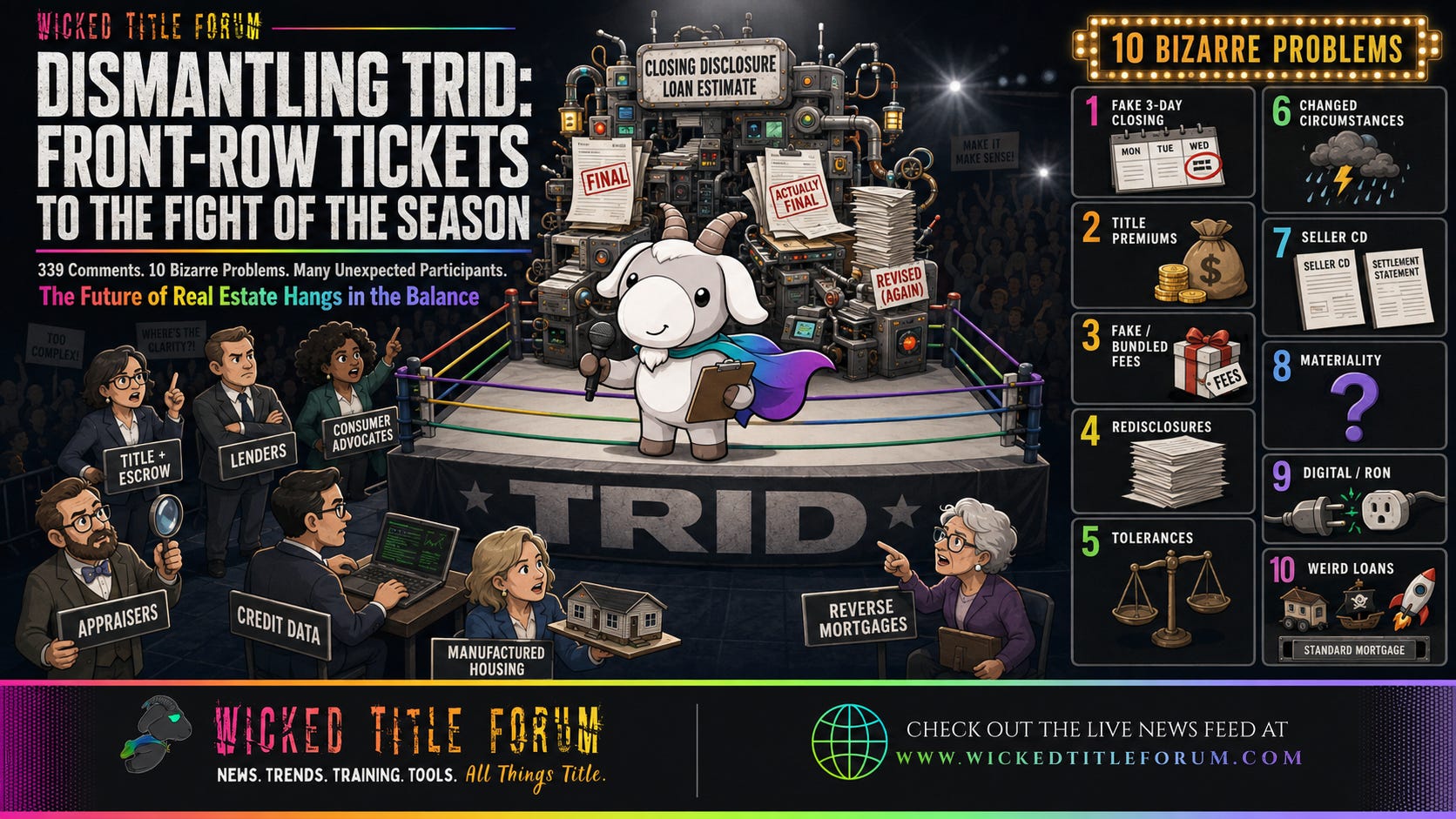
The most interesting thing about the CFPB docket is not that people think TRID has problems.
It is how many completely different problems they think it has.
Lenders are worried about timing, liability and tolerances. Title and escrow are worried about bad numbers, late coordination and rules that do not match the closing. Consumers are worried that “flexibility” will erase protections. Appraisers, credit-data companies and tech vendors found entirely different pieces of the disclosure they want CFPB to reconsider.

Here is the complaint file…
1. TRID Has a Redisclosure Addiction
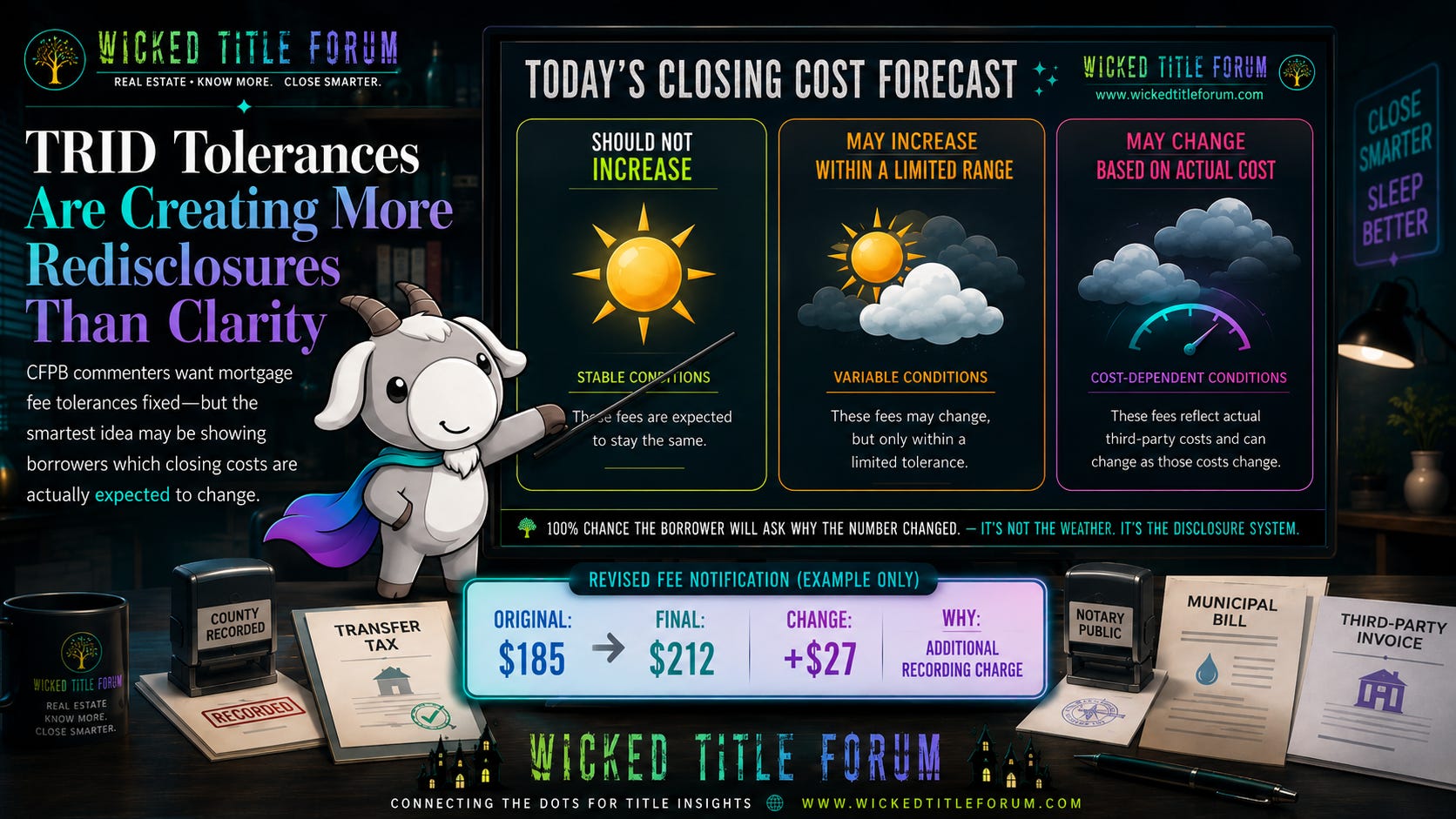
Lenders, title companies and escrow agents all complained about the number of redisclosures generated by ordinary transaction changes.
The joint mortgage-trade filing calls the tolerance system one of the most operationally burdensome parts of TRID and argues that it can punish immaterial variances instead of focusing on meaningful consumer cost information.
ALTA says consumers can receive multiple Loan Estimates and Closing Disclosures and arrive at closing unable to tell which one is actually accurate.
This is where the regulation starts eating its own purpose.
If the goal is clarity, giving the borrower Version 1, Version 2, Version 3, Version 4 and FINAL_v7_ACTUALFINAL.pdf may not be the triumph we think it is.
Stop Treating Every Government or Third-Party Fee Change Like Somebody Screwed Up
Transfer taxes change when the purchase price changes.
Recording fees are generally calculated based on number of pages in a document not delivered to title until the settlement day.
Notary costs are based on the number of documents being notarized, in a loan package not delivered to title until the day of closing.
Final taxes come from individual tax collectors with their own set of rules about how and when to disclose that information.
Payoff figures are finetuned through a daily interest calculation based on the day the lender received the payoff funds - change the settlement date, you change the payoff amount.
The parties renegotiate - everything.
Yet tolerance rules and “changed circumstance” determinations can treat those changes as though somebody failed to price the loan correctly. That’s unfair to the lender and burdensome on lenders and settlement professionals.
AEA specifically asks CFPB to reconsider the treatment of transfer taxes, recording fees and notary fees because they are externally determined, government regulated, charges the creditor and settlement agent do not control.
AEA also says creditors still interpret changed-circumstance rules differently, particularly when buyers and sellers renegotiate who pays a closing cost.
California Escrow Association asks CFPB to explicitly address HOA demands, payoff revisions, corrected tax bills, continuing buyer-seller negotiations and other common settlement events.
That does not mean consumers should eat unexplained surprises.
It means the compliance system should be able to tell the difference between:
the lender changed the price
the lender was lazy about communicating with title and providing final closing docs
and
the buyer and seller renegotiated
The tolerance fight is really about control.
If the creditor controls the charge or controls the information necessary to calculate the charge, holding the creditor accountable for the estimate makes sense.
If the creditor does not control the charge, the argument gets harder.
The comments repeatedly ask CFPB to draw that line more intelligently because the current system can encourage conservative estimates, cures and redisclosures instead of producing better information.
Sometimes TRID is protecting the consumer from a bad estimate.
Sometimes it is punishing somebody for failing to predict the future.
Those are different problems.
Brought to you by our friends, contributors & sponsors:🔒 Closinglock, 🌍 Foreign Tax CPA, 🪄Business Witch Academy, 🧱 Brickhouse Consulting, 🖊️Dotted Line Signings & Our Paying Readers
📢 Be a Sponsor
2. The Fake Three-Day Closing Disclosure

All of that redisclosure, tolerance, and change circumstances stuff leads us to Title and Escrow professionals telling CFPB that TRID’s three-day Closing Disclosure rule is not the real source of closing chaos. Their bigger complaint: the “final” CD can go out while balancing, underwriting and document preparation are still moving.
California’s Escrow Institute says its members are regularly asked to produce final numbers within 24 to 48 hours of closing on files that have been open for weeks. It argues that many corrected CDs are not caused by some dramatic late-breaking event. They happen because meaningful lender-settlement reconciliation starts too late.
Another title-company commenter described what the process has effectively created:
an “estimated final” Closing Disclosure.
Which may be the most perfectly absurd description of modern mortgage closing ever committed to a federal docket.
Estimated.
Final.
Pick one.
So the borrower gets three days with a disclosure that claims it’s final, but isn’t while settlement gets a mere hours with the version everybody is actually expected to sign and fund from.
The problem is not the consumer review period itself. It is pretending that “disclosed three days ago” and “financially finalized three days ago” are the same thing.
They are not.
Even the Lenders Admit the “Final” CD Isn’t Always Final

This is where the comments get really useful.
ICBA told CFPB that the current framework encourages lenders to issue Closing Disclosures before final settlement figures are available simply to satisfy the mandatory waiting period.
Community banks said lenders frequently provide CDs before all costs have been finalized because the timing rule requires the document to go out.
That works brilliantly if your compliance goal is:
CD DELIVERED ON TIME.
It works considerably less brilliantly if your consumer-protection goal is:
THE CONSUMER REVIEWED THE FINAL TRANSACTION FOR THREE DAYS.
Those are different achievements.
A closing attorney in the docket suggested title should receive at least one full business day to review the loan documents. I’d say it should be 6. The full loan package should arrive 6 days before settlement, allow title 3 days to review, balance the CD with the lender, and produce an actual, final CD in time to give the borrower 3 days to review it.
3. The Federal Government Made a Form So Clear Florida Had to Invent Another Form to Explain It

TRID was supposed to make mortgage costs easier to understand. Sometimes complying with it requires showing consumers numbers that aren’t the prices they actually pay.
Nothing explains TRID’s title-premium problem better than Florida.
Florida’s title association walked CFPB through the math in its public comment.
Take a $300,000 purchase with a $240,000 mortgage.
Under Florida’s filed title rates, the owner’s policy premium is $1,575.
The simultaneous-issue lender’s policy is $25.
Pretty straightforward.
Then TRID arrives.
The federally required Closing Disclosure shows:
Lender’s title policy: $1,275.
Owner’s title policy: $325.
Total: $1,600.
The total is correct.
Almost everything underneath it is nonsense.
The federal formula forces the lender’s policy to appear at its full standalone premium, then backs the simultaneous-issue discount into the owner’s-policy line. The consumer therefore sees $1,275 beside a policy that actually costs $25 under Florida’s filed rates.
And because Florida apparently believed consumers deserved to know what they were actually paying, the state created another mandatory form explaining why the federal form and the real title premiums do not match.
Yes. We created a disclosure to explain the disclosure.
A+ work, everyone.
Florida’s not alone in this dilemma. Texas has its own supplemental disclosure addressing the same basic problem.
ALTA made fixing this its first and most important recommendation to CFPB.
Hard to argue with that one.
A consumer disclosure should probably not require a second disclosure explaining why the first disclosure is wrong.

4. Fix the Fake Fees Already
Title is not alone.
One of the strangest patterns in the docket is how many industries are telling CFPB:
That fee line looks much simpler than the thing it is supposedly explaining.
Approximately Every Appraiser in America Found the Comment Button
The appraisal contingent is one of the strangest and most organized subplots in this docket. Their campaign centers on the combined Appraisal Fee.
The Appraisal Regulation Compliance Council asks CFPB to require separate disclosure of:
Appraiser professional fee
and
Appraisal management company fee.
Its argument is that a consumer can see one appraisal charge without knowing how much was actually paid to the licensed appraiser and how much was retained for appraisal-management services.
Equifax Showed Up to Ask What a “Credit Report Fee” Actually Is
This one I did not have on my bingo card.
Equifax spends much of its filing defending the continued value of tri-merge credit reporting and discussing credit-data costs.
Commercial interest noted.
But then it gets to an unexpectedly good disclosure question.
Equifax says mortgage lenders can calculate credit-report charges using different methodologies, including:
the actual products used for that borrower;
an averaged methodology; or
a closed-loan/funded-loan methodology where the consumers who successfully close may absorb costs associated with applications that did not.
Equifax wants CFPB to require greater clarity about which methodology produced the charge.
And again we arrive at the same uncomfortable question:
If the Closing Disclosure says:
Credit Report Fee: $X
but $X is not necessarily the actual cost of that consumer’s credit report—
what exactly is the line telling them?
Three very different industries have arrived at essentially the same complaint:
A short label and a precise dollar amount do not automatically create transparency.
Sometimes simplification just hides where the money went.
Both ALTA and American Escrow Association (AEA) also want another old irritant addressed: the mandatory “(Optional)” label on owner’s title insurance, which they argue can be misleading where the purchase contract effectively requires the policy even though the lender does not. Not to mention, most people equate “optional” with “unnecessary” which could be leading homeowners to make poor risk management decisions based on a single word, and inaccurate number.
Ten years into TRID, perhaps the form could stop requiring title agents to explain why the official disclosure does not mean what it appears to mean.

Brought to you by 🔒 Closinglock: Protecting the people behind every home closing, get a Demo Today!
5. Should We Keep the 3 Day Right of Recission if we have a 3-Day Disclosure?

For certain transactions involving a consumer’s principal dwelling—most notably many refinances—federal law gives the borrower a period after consummation in which they can cancel the transaction.
On July 20th in “TRID Is Back on the Operating Table—and Someone Brought a Chainsaw: What Title Agents Need to Know“ I said, “I’d love to see some statistical data from the lenders on how often buyers are rescinding both pre and post TRID, but I was unable to find any.”
Ask and ye shall receive, sometimes.
United Wholesale Mortgage brought some valuable numbers to the CFPB.
According to UWM, across 419,667 owner-occupied refinance loans originated from 2023 through Q2 2026, UWM says just 1,266 borrowers exercised their right to rescind during the three-business-day post-closing window.
That is a rescission rate of 0.302%.
In other words:
99.698% of those borrowers did not use the protection.
UWM’s conclusion is straightforward. Consumers already receive a Closing Disclosure three business days before consummation. They have time to review the loan before they sign it. Very few borrowers subsequently cancel. UWM argues that TRID has made that protection largely redundant.
But low use does not necessarily mean low value, and the National Consumer Law Center and other consumer groups strongly disagree.
It will be interesting to see where the CFPB lands.
6. The Seller Closing Disclosure Has Been Nominated for Retirement

Settlement already has to account for the seller’s proceeds, charges, credits, payoffs and disbursements. And title companies routinely prepare settlement statements that do exactly that.
ALTA told CFPB that settlement companies continue to use the ALTA Settlement Statement because the Closing Disclosure does not fully explain the economics of the actual transaction. Yet again, we’ve had to make a form to explain the form. Why?
So both ALTA and the American Escrow Association ask an obvious question:
Why are we also preparing a separate seller Closing Disclosure?
Both the American Land Title Association and settlement-industry commenters asked CFPB to reconsider the requirement for a separate seller Closing Disclosure. Their proposed answer is not particularly radical:
Let the settlement statement we are already preparing do the job.
This is probably one of the easiest, least expensive, least controversial, yet truly valuable changes that could be made.
7. “Materiality” Sounds Great Until Somebody Has to Fund

CFPB commenters agree trivial mortgage changes should not derail closings. The fight is over whether replacing bright-line TRID rules with judgment calls would fix the problem—or create a new one.
A lot of lender-side commenters like materiality.
And why wouldn’t they?
If a change does not meaningfully affect the borrower, maybe it should not trigger another compliance event. Then escrow asks the question everybody eventually has to answer:
What exactly is material?
California Escrow Association points out that the settlement agent holding trust funds may not have access to the lender’s underwriting file or compliance analysis. It still has to know whether the waiting period has been satisfied and whether the money can legally move.
Consumer advocates also object to vague materiality standards, warning that they can replace clear protections with interpretation and litigation.
Materiality could absolutely fix stupid delays. So could better bright-line rules.
8. The Law Is Still Catching Up With the Closing Technology

Electronic signatures are not new.
RON is not new.
eNotes are not new.
Digital closings are not new.
What remains remarkably durable is inconsistency.
American Escrow Association wants clearer federal guidance on electronic delivery, consent, signatures and proof of receipt because lender practices still vary. ALTA raises the same problem.
Snapdocs goes considerably farther. It asks CFPB to consider requiring covered lenders to offer a digital closing option when the transaction and documents are legally and operationally eligible, while preserving the borrower’s ability to choose paper or hybrid execution.
That is not just:
Please clarify eSign.
That is:
Maybe digital closing should become something the consumer can expect to be offered.
For lenders and title, that would mean another round of figuring out whether the state, county, investor, warehouse, custodian, insurer, guarantor, eNote system, notary law and actual document package have all decided to join us in the twenty-first century. But honestly, we’re already doing that now. Maybe the CFPB could give them a nudge?
The technology problem is increasingly not whether the tools exist.
It is whether everybody in the transaction agrees they exist at the same time.
9. The Emergency Waiver Is Almost Too Scary to Use
There is a strange little emergency exit built into TRID.
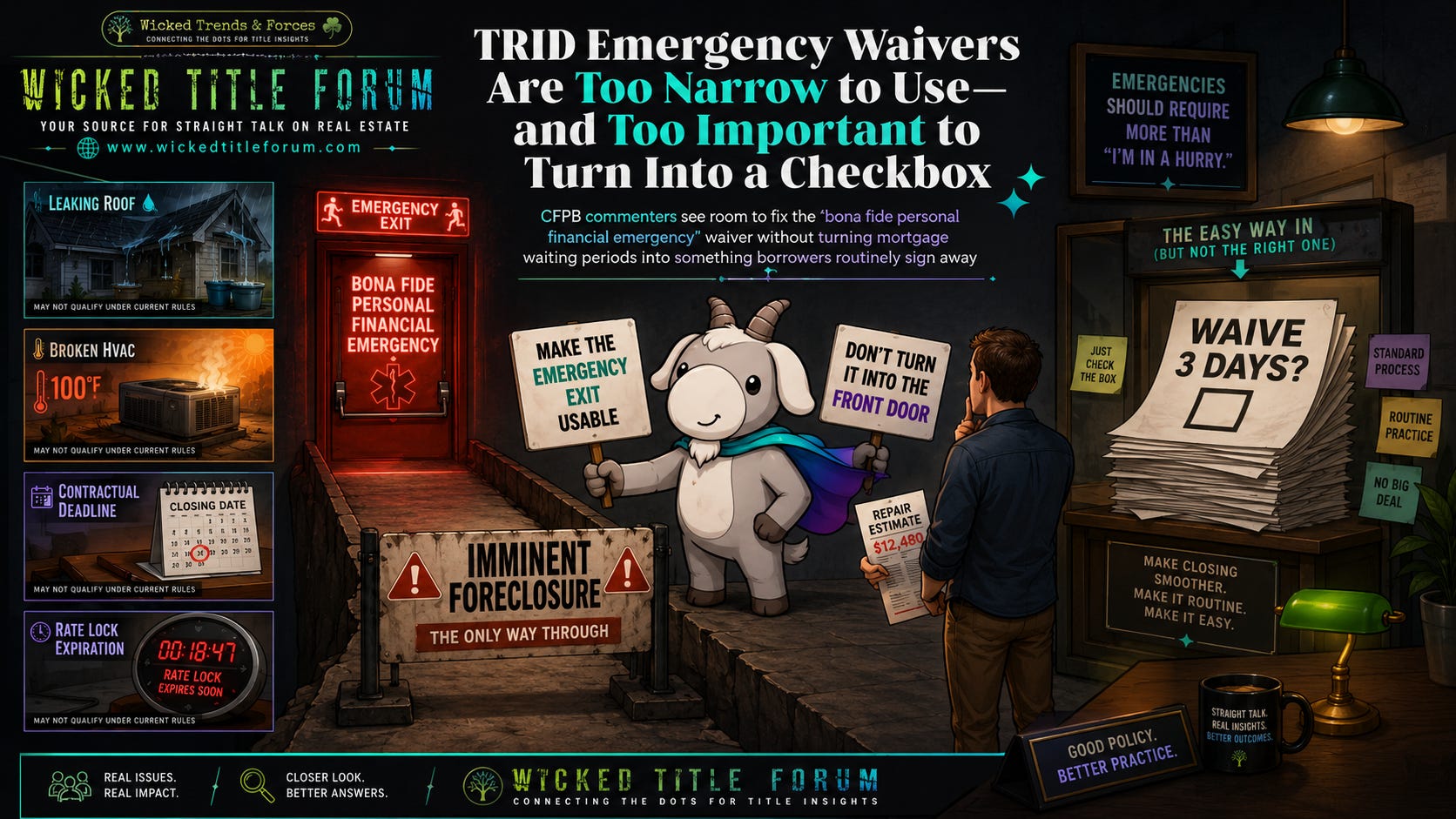
If a borrower has a bona fide personal financial emergency, certain waiting periods can be waived. Sounds useful. Then you look at the regulatory example.
The famous example is essentially:
Your house is about to be sold at foreclosure unless the loan funds arrive during the waiting period.
That is certainly an emergency. It is also a spectacularly narrow example to leave sitting there as the industry’s main guide to what qualifies.
Meanwhile, actual homeowners experience other situations that also have a rather urgent quality:
The roof is leaking.
The air conditioner dies during a heat wave.
A purchase contract is about to expire.
A rate lock is expiring.
A time-sensitive refinance needs to fund.
And everybody involved starts asking the same question:
Does this count?
That is exactly the kind of question a regulatory waiver is supposed to answer.
Instead, the comments suggest the current framework has created a lovely compromise in which the waiver technically exists and many people are too scared to use it.
The mortgage trades want CFPB to recognize things like expiring rate locks, loss of earnest money, occupancy deadlines and contractual penalties.
PACE gives this issue an unusually intuitive fact pattern.
BRIDGE, which represents third-party administrators of state-authorized PACE financing programs, spends a surprising amount of its CFPB comment on this. BRIDGE asks CFPB to imagine a homeowner who needs:
a new air-conditioning system during a summer heat wave;
major roof repairs during rainy season;
or another urgent improvement affecting health, safety or habitability.
Its argument is that stacking the various TRID timing requirements with rescission can produce a delay of at least thirteen business days in the scenarios it describes.
Consumer advocates, meanwhile, have a very reasonable fear: Make the waiver too easy and it becomes another preprinted document in the signing package. NCLC specifically warns that preprinted or model forms could be slipped into electronic or paper closing packages and become routine rather than exceptional. It argues the current requirement—that the consumer provide a written statement describing the emergency—helps ensure the waiver remains consumer-driven instead of becoming another document an originator can normalize.
That concern deserves more than an eye roll.
ALTA wants CFPB to broaden the examples and supports the idea of a model form. California’s independent escrow companies explain why this is not just another lender-compliance question. Escrow holders are frequently pulled into waiver situations because somebody has to know whether the transaction may legally proceed and whether funds may be disbursed. Any change needs to include clear direction on who is responsible for making the determination, preferably the lender, and clear instruction that title and escrow can rely on that determination to fund. Otherwise title will inherit another federal judgment call somebody else asked for.
Three years later:
“Everybody signs that.”
There is quite a lot of room between:
Your house must practically be on fire before we can safely recognize an emergency
and
Check this box if you are busy Friday.
CFPB should probably find that waiver middle ground because not every deadline is an emergency just because everybody is upset.
10. TRID Was Built for a Standard Mortgage. Unfortunately, Housing Finance Has Met Real Estate.

CFPB’s TRID comments expose a structural problem: manufactured housing, construction-to-permanent loans, reverse mortgages, PACE and digital closings do not fit one standard mortgage disclosure system. How much specialization can TRID absorb before “integrated” stops meaning integrated?
Reverse mortgages walk in backwards. Construction loans do not have all their costs neatly known at application. PACE says we aren’t even a mortgage, yet here we are. It can involve property-improvement financing where urgency and transaction structure look nothing like a conventional purchase loan. Manufactured housing can involve a house seller, land seller, site work, affixation, titling issues involving the department of motor vehicles and assorted other ways to make a standard Closing Disclosure question its career choices.
Commenter after commenter asks CFPB for some version of tailored treatment.
And many of them have a point.
The danger is what happens next because diversity is a feature and compliance hates features.
Every specialized rule means new forms, new programming, new training, new lender overlays and another decision tree for settlement.
ALTA supports tailored approaches in areas such as construction and reverse mortgages but also reminds CFPB that the title industry spent more than $300 million implementing TRID in 2015.
That is worth remembering before anybody enthusiastically invents:
TRID Classic.
TRID Construction.
TRID Reverse.
TRID Manufactured.
TRID Small Lender.
TRID Digital Deluxe.
TRID PACE Emergency Roof Edition.
Because the lender may only need to implement the rules that apply to its product.
The title agency gets everybody.
Everybody Hates TRID Until You Ask What They’d Replace It With

There is something almost beautiful about 339 public comments on TRID.
Everybody arrives furious.
Lenders are tired of paying cures on fees they don’t control. Credit unions are drowning in technical compliance. Escrow companies want numbers before the day of closing. Consumer advocates think “flexibility” is a lovely word for “future loophole.” Title professionals would simply like the federal disclosure to stop requiring them to explain why the federal disclosure is wrong.
Then CFPB asks the dangerous question:
Fine. What should we do instead?
And suddenly the consensus gets wobbly.
The public-comment fight is much more interesting than “industry wants deregulation.” The real fight is over how do we support a diverse housing marketing with diverse financial solutions while limiting regulatory uncertainty and assumed financial risk?
None of these financial solutions becomes easier to understand because we force them to dress alike. The consensus is that TRID’s currently too rigid.
Title’s job in that debate is exactly what it has always been: look past the policy slogan and ask what happens when this rule hits an actual transaction, with actual money, actual documents and a consumer sitting across the table expecting somebody to know what the hell is going on.
There are absolutely parts of TRID that deserve surgery.
But before CFPB starts handing out “flexibility,” somebody needs to ask where the risk goes when the rules stop giving a definite answer.
Because eventually the file lands somewhere.
Usually on our desk.
📌 Free content keeps you informed. Paid keeps this independent.
If you want the unfiltered version of this industry—back it.
Stay Wicked,
Cheryl
Founder, Wicked Title Forum
From Chaos to Clarity—in Plain English
Contact Me (or hit reply)
🐐 Membership | 🔍 Find Answers | 🛒 Shop | 📢 Partner With Us

The Wicked Title Forum is a collaborative resource. If you spot something outdated or inaccurate, leave a comment—we’ll get it fixed.
**DISCLAIMER**
Content is for informational purposes, operational awareness and workflow strategy. While every effort is made to ensure accuracy, it is not meant to be a compliance directive or replace the specific legal/financial advice of your retained experts. As always evaluate new information & tools with your underwriter/attorney, accountant/financial advisor, IT/security team, and internal policies, as needed, before implementation.
This site is partially supported by sponsor ads and sponsored content.