




🐐 Search the Knowledge Base | 🔔 Upgrade Now | 📢 Be a Sponsor
Brought to you by: 🦅FinCEN Report
Last week, the American Land Title Association (ALTA) sent an open letter to FinCEN in response to the now-paused Residential Real Estate Reporting Rule.
If you haven’t read it yet, there’s a link at the end.
Alongside that letter, ALTA released survey data from nearly 1,300 industry professionals detailing what actually happened when title companies tried to comply with the rule.
And the results?
Messy. Expensive. Operationally disruptive.
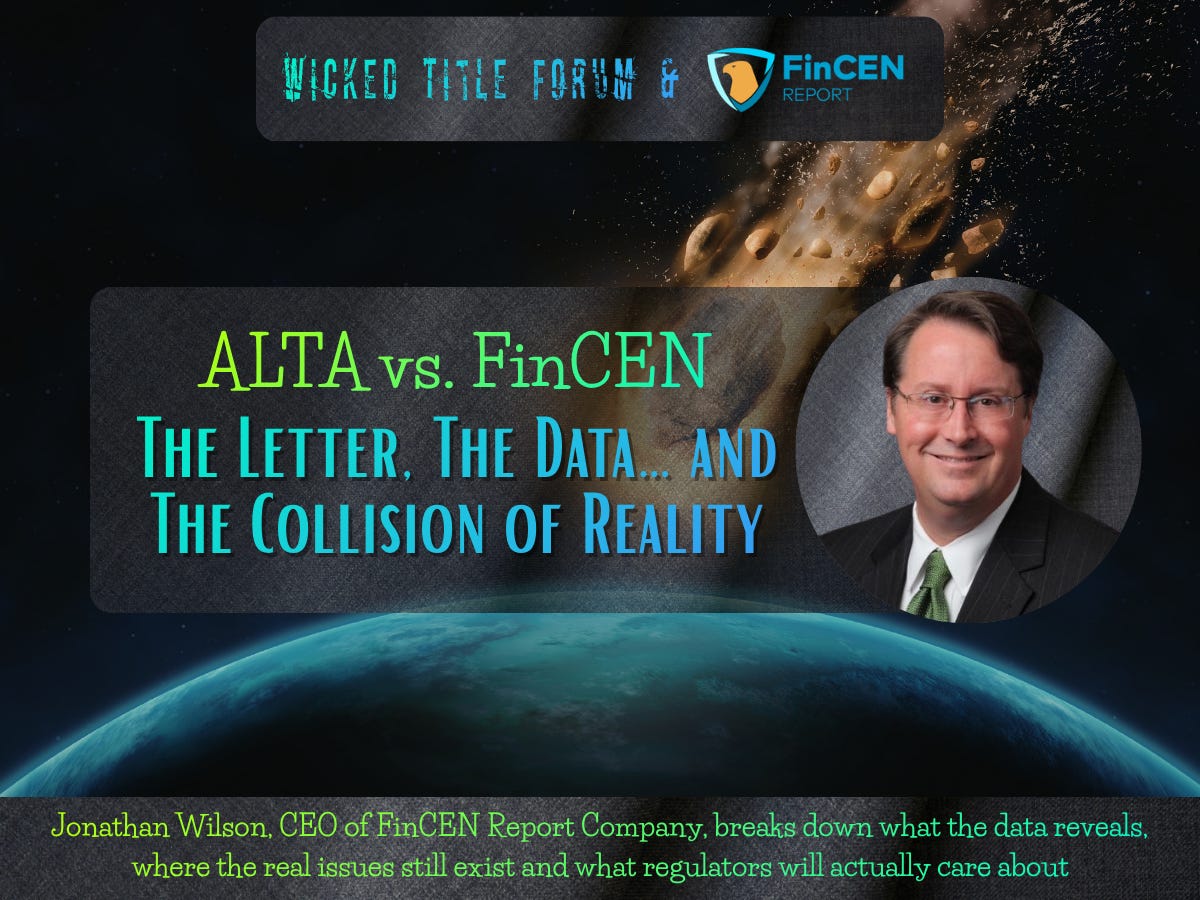
So, I sat down with Jonathan Wilson, CEO of FinCEN Report Company—someone who wasn’t just watching this unfold…he was actively helping title companies process and file these reports in real time.
Jonathan has a front-row seat to:
What actually broke in practice
What ALTA got right (and wrong)
And how FinCEN is likely to interpret all of this
🎥Watch the Full Interview Here
Before we got into the nitty-gritty, Jonathan said the part that nobody’s saying out loud, but matters the most:
“The fact that ALTA is writing this letter at all is interesting… if you thought the rule was going away forever, why would you bother?”
That’s the part most people are missing.
Because this letter?
This survey?
It’s not a victory lap.
It’s a positioning move for what comes next.
ALTA didn’t write that letter because they think this rule is dead.
They wrote it because they know it’s not.
The court may have hit pause on FinCEN’s Residential Real Estate Rule—but behind the scenes?
Everyone serious in this industry is already preparing for Round 2.
⚠️ The Data Shows Real Friction
ALTA’s survey makes one thing clear: this wasn’t a minor compliance headache—it had real impact on how transactions moved.
Roughly two-thirds of companies experienced closing delays tied to the rule
That alone is enough to tell you this didn’t slot neatly into existing workflows. Delays weren’t isolated—they were widespread.
But the bigger issue? Consumer resistance.
About 85% of agents reported buyers or sellers raising privacy or data security concerns
Over half encountered pushback tied to delays or timing issues
Nearly half had clients outright refuse to provide required information
And operationally, the burden landed exactly where you’d expect:
Collecting required data
Identifying beneficial owners
Explaining the rule to confused (and skeptical) clients
Training staff to handle something completely new
This wasn’t “add a form and move on.”
It introduced delays, created friction with consumers, and forced many companies to build entirely new processes just to get through a file.

🧠 But Here’s the Part Agents Need to Understand
While the reported experiences are interesting and valuable to industry as a whole if/when this rule comes roaring back to life, Jonathan Wilson made a point that’s easy to overlook—but critical to understand:
“I’m not really sure how persuasive that is to the government… things are sometimes going to be a pain…Taxes are a pain, but we still have to do them every year.”
“This is hard” is not a winning argument.
Not in this context.
Because ALTA and FinCEN are operating from entirely different perspectives.
ALTA is arguing from operations:
This slows closings, frustrates customers, and adds cost.
FinCEN is operating from enforcement:
Does this help identify and track illicit money?
Those aren’t opposing viewpoints.
They’re completely different objectives.
And Jonathan and I aren’t confident that FinCEN is going to care enough about ALTA’s objectives (even if the rest us agree that those objectives should be important.)
If the rule produces usable data for law enforcement, the friction it creates in your workflow is probably not a dealbreaker—it’s collateral damage.
That’s the reality.
Not because FinCEN doesn’t care at all about the burden (maybe they do), but because burden alone isn’t a reason to abandon a tool they believe works.
The better question is:
👉 Where does this break down in a way that undermines the rule itself—not just your process?
Because that’s the argument that actually moves the needle.
📉 ALTA’s Wish List: Helpful… But Some Of It Is Probably Not Happening
Jonathan said, “ALTA believes that the real estate rule is going to come back one day… and if it does, they want to get some additional exemptions thrown in to lighten this burden.” Which is a good thing.
But we need to be honest about the proposed fixes.
ALTA asked for:
Dollar thresholds
Entity-to-self transfer exemptions
Foreclosure exemptions
Reduced data collection about
Payment information
Seller info
Some of these make operational sense.
But from a regulatory standpoint?
Most of them create loopholes big enough to drive a shell company through.
Jonathan, provided this example:
“If you’re money laundering, you might sell the property for a dollar on paper and shift the money outside the oversight of the title agency… and now you’ve circumvented the rule.”
That’s the problem.
What simplifies your workflow may weaken enforcement and FinCEN isn’t going to trade one for the other easily.
🔍 The “Workaround” That Actually Proves FinCEN’s Point
One of the most interesting survey findings:
👉 Buyers started restructuring transactions to avoid reporting.
At first glance, that sounds like a problem.
It’s not.
“From FinCEN’s point of view, that’s entirely okay… now the land records show who bought the property.” - Jonathan Wilson, FinCEN Report Company
Let that sink in.
If someone abandons an entity purchase and buys in their own name to avoid reporting…
FinCEN just won anyway.
Because the entire goal of the rule is to:
➡️ Break anonymity
➡️ Expose beneficial ownership
➡️ Make people traceable
So when agents say:
“People are changing how they buy to avoid reporting”
FinCEN hears:
“Great. It’s working.”
⚙️ Where does this break down in a way that undermines the rule itself—not just your process?
The survey results and ALTA’s letter do a good job highlighting where the rule created friction for title companies.
But there’s a second layer to that conversation—one that matters just as much.
When I spoke with Jonathan Wilson, CEO of FinCEN Report Company, his perspective wasn’t just about where the process felt difficult.
It was about something more fundamental:
👉 Where do the mechanics of the rule not fully align with how real estate transactions actually work—and what does that means for the quality of the reporting itself?
Because at the end of the day, this isn’t just about whether the process is burdensome.
It’s about whether the rule, as written, can consistently produce clear, reliable data in a real-world closing environment.
And that’s where ALTA’s fourth change request, we feel, is the strongest contender for change.
1. FinCEN Is Asking for Data That Doesn’t Exist in Our World
“Total Consideration” is too vague to produce reliable reporting.
Under the rule, “total consideration” is treated as the full sum of value exchanged in a transaction—not just the purchase price, not just the funds moving through escrow, but potentially all payments made by anyone, from any source, tied to the deal.
That’s where the disconnect starts.
Because in a real closing, title agents don’t have a single, definitive record of all value exchanged. They have:
the contract and contract price
the settlement statement
the funds actually received and disbursed
Those are documented. Verifiable. Tied to the file.
What they don’t have is complete visibility into:
payments made outside of closing
side agreements between parties
indirect or layered transfers of value
contributions coming from multiple upstream sources
Exchanges of goods or services of value such as personal property or home repairs
And yet, the rule implicitly asks them to report a number that assumes that level of visibility exists.
So what happens?
The reporting agent is forced to:
reconstruct a number that isn’t formally documented, anywhere
rely on information provided by parties who may not fully disclose it
make judgment calls about what should or should not be included
That’s not just an operational inconvenience.
👉 It creates a situation where the same transaction could be reported differently by different agents.
And that’s where this stops being a title problem and becomes a FinCEN problem.
Because if:
one agent reports only escrowed funds
another includes additional disclosed payments
another attempts to estimate total value based on partial information
Then the dataset FinCEN receives is no longer standardized.
It’s fragmented. And fragmented data is difficult to:
compare across transactions
aggregate into meaningful patterns
rely on for enforcement decisions
The rule is asking for a level of financial completeness that the closing process itself does not consistently capture.
Until that gap is addressed, the issue isn’t whether agents can comply.
It’s whether the reporting framework can produce consistent, decision-useful data at scale.
What Would Work Better
If FinCEN wants consistent, usable data, the rule needs to align with what can actually be known and verified at closing—not reconstructed after the fact.
Define reporting around purchase price, cash to close, and loan amount
Allow document-based reporting (e.g., upload the settlement statement) instead of calculated totals
Limit source reporting to funds that actually move through the escrow account and where they originated
2. Payment Information Reporting Breaks at the Point of Collection
The rule doesn’t just ask what was paid—it asks how every dollar moved:
Source of funds
Account-level information
Multiple parties contributing funds
This is the part of the rule that seems to have created the most friction for a reason: it pushes settlement agents to report highly granular payment information that may not be fully visible or verifiable in a normal closing.
On paper, that sounds like it creates transparency.
In practice, it creates a trust problem. Jonathan described it as “one of the most difficult aspects… explaining why we were asking for very detailed, confidential information.”
That matters because a reporting system is only as strong as the information its reporters can realistically collect.
Here’s the reality agents are dealing with:
Buyers don’t want to hand over banking details
Funds come from multiple sources (and sometimes multiple transactions)
Not all money flows are visible to the title company
And timing makes it worse.
👉 You’re collecting this at the end of the transaction
👉 When everyone expects to sign and be done
As one survey response put it:
“At the beginning… no one knows the payment information. At the end, collection feels like a surprise.”
So instead of a smooth closing, you get:
Delays
Pushback
Last-minute scrambling
What Would Work Better
If the goal is to trace funds without breaking the process, the reporting needs to focus on what can be consistently observed and documented at closing.
Settlement agents can reliably report:
funds they receive
funds they disburse
the instruments used (wire, check, etc.)
What they cannot consistently verify is:
upstream sources of those funds
account ownership beyond what’s provided
whether all contributing parties have been fully disclosed
We propose FinCEN could improve this by:
Requiring reporting of funds received and disbursed by the settlement agent, including method (wire, check)
Capture account identifiers from transaction instruments (e.g., wire details, check info), not full upstream tracing
Shift deeper source-of-funds verification to financial institutions, where that visibility already exists, during an investigation.
This keeps the data:
consistent across transactions
tied to verifiable documents
usable for pattern detection
Without forcing settlement agents to report what they can’t reliably see and creating trust issues with consumers that could backfire in unforeseen ways.
🧠 The Smartest Ask ALTA Made of FinCEN
Overall, our favorite ask from ALTA has to be, that if reporting resumes in the future, that FinCEN provide:
👉 90 days’ notice before enforcement resumes
👉 Define reportable transaction under the restart, based upon purchase agreement date, rather than the closing date.
That request is clear, reasonable, actionable. We hope FinCEN is listening.
🧩 Staying Informed and Prepared
What makes this situation particularly uncertain is the potential for rapid changes. Jonathan Wilson emphasizes that title professionals should remain vigilant for developments, as the situation could shift with little notice, despite ALTA’s clear request to the contrary.
Changes could come through a decision on the government’s appeal, a ruling on a stay request, or even a new regulatory action from FinCEN.
When this comes back, you’re not going to “figure it out on the fly” again.
You’ll either:
Have a system
Or be run over by the system
And those are very different experiences.
If you want to:
✔ Quickly determine if a transaction is reportable
✔ Avoid guessing on complex scenarios
✔ Keep your workflow moving without blowing up your closing
👉 FinCEN Report Company is already doing this—right now.
Even with the rule paused, some agencies are still running their processes and filing reports to stay ready.
Because they understand something critical:
Preparation is cheaper than panic.
👉 Take a look. Test your process. Get ahead of it.
Still have questions?
Be sure to stop by the FinCEN Report Company Booth at these upcoming events:
🎟️ATIM
📅 April 15th-17th | ⏰ All day | 📍 New Orleans, Louisiana
🎟️FORES
📅 April 27th-29th | ⏰ All day | 📍 Austin, TX
Don’t Miss Jonathan on the Navigating the FinCEN Residential Real Estate Reporting Rule Panel on Wednesday the 29th! ⏰8:30am
And don’t forget to 🦅 Sign Up for the FinCEN Report Company Case Tracker for Updates
🛠 The Real Opportunity You Don’t Want to Miss
Everyone’s focused on:
“Will this rule come back?”
Wrong question because we already know that all the evidence reads like a Magic 8 Ball, “Probably, Yes.”
The better question is:
👉 How do we build a process that makes this as easy as possible?
When FinCEN issued the rule initially, they offered it up for a period of public comment. With any luck, we’ll be afforded that opportunity again in the future. So start thinking about it now.
Where did the expectations of the rule fail to match up to real world scenarios?
What were the edge cases and unusual circumstances no one planned for?
Be ready to speak up, loud and clear, if we’re given the opportunity. They listened to the comments the first time around and made some really great adjustments. It’s one of the rare times that you can meaningfully impact the shape of our government. Don’t miss it.
Further Resources:
Brought to you by: 🦅FinCEN Report
📌 If this helps you do your job better, faster, or safer—support it.
Stay Wicked,
Cheryl

🐐 Search the Knowledge Base | 🔔 Upgrade Now | 📢 Be a Sponsor
⚠️ Quick Reality Check:
This article is for informational purposes, operational awareness and workflow strategy—not a legal/financial advice, product endorsement or compliance directive. Always evaluate new information & tools with your underwriter/attorney, accountant/financial advisor, IT/security team, and internal policies before implementation.
Some links may be affiliate or sponsor links. That means I might earn a commission—at no extra cost to you.


