


🐐 Membership | 🔍 Find Answers | 🛒 Shop | 📢 Partner With Us
Brought to you by our friends, contributors & sponsors:🔒 Closinglock, 🌍 Foreign Tax CPA, 🪄Business Witch Academy, 🧱 Brickhouse Consulting, 🖊️Dotted Line Signings & Our Paying Readers
📢 Be a Sponsor
Your Website Vendor Has Some Explaining to Do
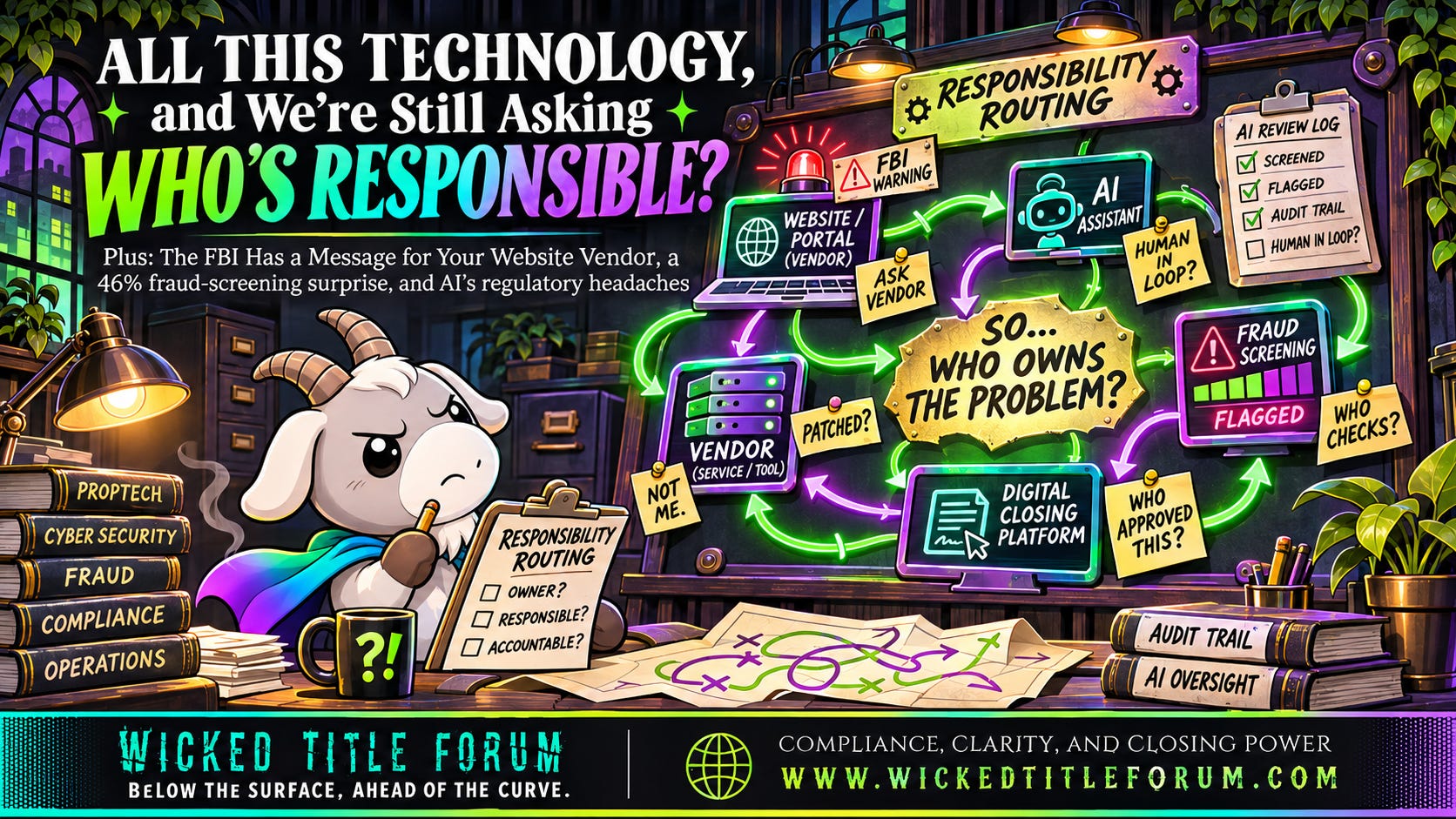
Some of this week’s biggest technology stories aren’t really about technology. They’re about ownership: who is responsible for the website nobody checks, the AI account nobody inventoried, the warning nobody resolved, or the new closing platform nobody has tested on a difficult file.
Your Website Vendor May Have a Critical Problem. Who’s Checking?
Two critical PHP vulnerabilities flagged by the FBI could allow remote code execution on affected web systems. PHP is widely used behind websites, forms and portals; the FBI says vulnerable installations should be patched immediately. Merely using PHP doesn’t establish that a particular system is exposed.
The Land Title Association of Alabama’s warning exposes the business problem: title agencies often don’t know which outside provider manages the software running behind their public-facing services. Website developer? Hosting company? IT contractor? Portal provider? Each may assume someone else owns the update.
Don’t send a generic “Are we secure?” email. Ask whoever manages each internet-facing system whether it uses PHP, whether CVE-2026-109618 or CVE-2026-109619 applies, what patched version is installed, and who verified the fix. Get the answer and responsible party in writing. The FBI advises taking affected systems offline if they cannot be promptly mitigated.
The lesson extends well beyond this patch: a vendor list that doesn’t identify who maintains critical systems isn’t much of a control.

ALTA’s Vendor Definition Just Got Uncomfortably Broad
Under ALTA Best Practices 5.0, vendors aren’t limited to companies on your accounts-payable report. The updated definition includes AI agents, chatbots and virtual assistants—even when you pay nothing and simply provide company information. Certain social-media platforms are included, too.
That leaves an immediate management question: which tools are employees actually putting company or customer information into, and who approved them? The framework is voluntary, not a new law. But an agency can’t evaluate vendor risk when its official vendor list is missing the tools people use every day.
🔒 Free readers got the story. Paid members got the “Okay, now what?” version.
A Fraud Flag Is a Question. Who Owns the Answer?
A striking 45.91% of transactions in FundingShield’s screened Q3 portfolio had discrepancies presenting potential wire or title risk. That’s not a 46% fraud rate, or a national estimate. The vendor examined a portfolio exceeding $108.7 billion in collateral; affected transactions averaged 2.3 issues, including CPL, licensing and wire-instruction problems.
Meanwhile, FNF’s expanded ionFraud tools allow participating agents to review bank-account age and ownership indicators. Useful signals, yes. Proof that a transaction is safe, no.
The operational question is what happens after a flag appears. Who investigates it? What independent evidence closes it? Who can approve the wire after an exception, and where is that decision recorded? Better detection without a defined resolution path just produces a more sophisticated backlog.
AI Regulators Are Asking for an Audit Trail
As of October 1, 24 states and Washington, D.C., had adopted AI guidance modeled on the NAIC bulletin. It concerns insurers, not automatically every independent agency.
Still, the management principle travels: when software influences a consequential decision, someone should know what data informed it, who reviewed it and how errors get corrected. If your file notes end with “AI checked it,” the audit trail probably ends too soon.
🔒 And that’s just the surface. Paid members got a closer look at what’s lurking underneath.

Mortgage Connect’s Digital Closing Deal: Test the Handoffs
Mortgage Connect acquired a majority interest in Stavvy and plans to combine its operations with Simply Secure Sign. The proposed offering brings eClosing, remote notarization, digital notes and eVault services closer together. The acquisition is complete; the operational integration is a plan.
For settlement partners, one platform sounds appealing until a file needs a hybrid closing, an exception to electronic eligibility or a handoff to another system. The useful adoption test is how those departures from the happy path are routed, documented and supported—not how many features fit on the sales sheet.
Title Lens Promises a Two-Minute Review. Then What?
TrueFocus says Title Lens checks title-search and mortgage-document packages against 20 quality-control and fraud criteria in a typical one to two minutes. Those are vendor claims, not independently verified error-detection rates.
Speed helps only if the output reaches someone empowered to act. Before adding automated pre-underwriting review, ask what triggers a flag, how it cites supporting evidence, which issues require a human decision, and whether the tool can fit into your existing exception queue. If a fast scan merely creates one more inbox to monitor, you’ve automated the easy part.
Worth Your Time
When a fraudulent wire is discovered, here’s the response sequence: Qualia’s guide covers notifying leadership, immediately calling the sending bank to seek a recall, reporting to IC3 and contacting transaction parties. The practical lesson: assign those roles and keep the contacts accessible before an incident.
AI is a research assistant, not a notary-law authority: Dorothy Hibbett’s useful test is to ask for the relevant state source, open it and check that it actually supports the answer. State-specific notarization decisions still belong to the commissioned professional.
📌 If this helps you do your job better, faster, or safer—support it.
Upgrade your membership and keep this kind of work independent, honest, and actually useful.
Stay Wicked,
Cheryl
Founder, Wicked Title Forum
Because knowing what’s happening isn’t the same as knowing what to do about it.
Contact Me (or hit reply)
🐐 Membership | 🔍 Find Answers | 🛒 Shop | 📢 Partner With Us

The Wicked Title Forum is a collaborative resource. If you spot something outdated or inaccurate, leave a comment—we’ll get it fixed.
**DISCLAIMER**
Content is for informational purposes, operational awareness and workflow strategy. While every effort is made to ensure accuracy, it is not meant to be a compliance directive or replace the specific legal/financial advice of your retained experts. As always evaluate new information & tools with your underwriter/attorney, accountant/financial advisor, IT/security team, and internal policies, as needed, before implementation.
This site is partially supported by sponsor ads and sponsored content.